
No products in the cart.
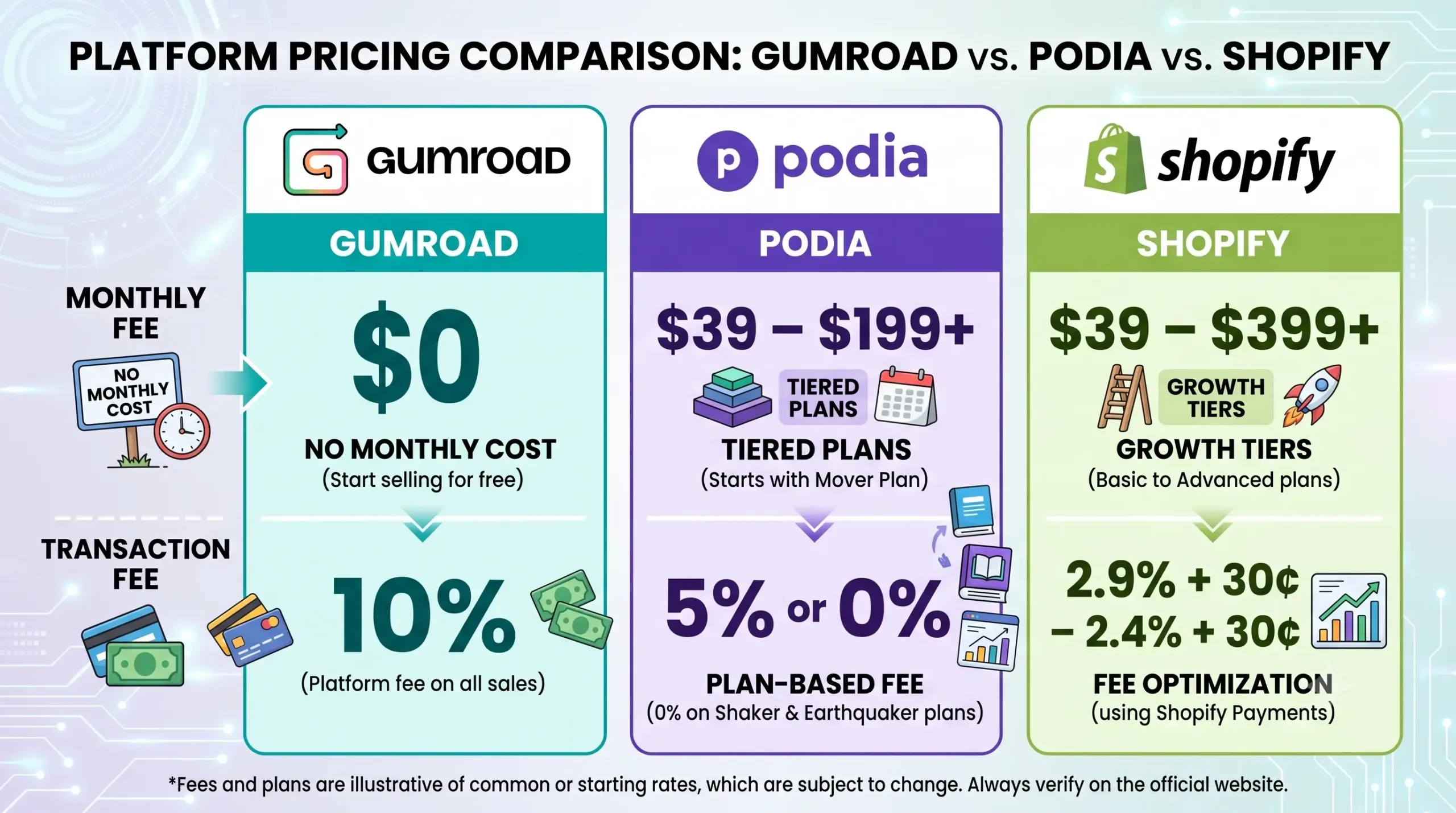
The Problem: Three Platforms, One Confusing Decision
You’ve built the thing. Now you need somewhere to sell it — and the internet hands you three names on repeat: Gumroad, Podia, Shopify. Each one claims to be the answer. None of them mention that the “right” choice depends entirely on what you’re actually selling and how much volume you’re doing.
Picking wrong isn’t fatal. It’s just expensive, in the quiet way — fees you didn’t budget for, features you paid for and never used, migrations you’ll do twice instead of once.
The Agitation: Why “Just Pick One” Backfires
Here’s what actually happens to most creators. They read one blog post, pick whichever platform got mentioned first, and sign up without doing the math on their own numbers. Three months later they’re either:
- Paying a flat monthly fee for a full storefront they didn’t need, or
- Bleeding percentage-based fees on volume that’s outgrown the simple option, or
- Stuck on a course platform trying to sell physical merch bundles it was never built for
Each platform is optimized for a genuinely different business shape. Gumroad wants your first sale to cost nothing upfront. Podia wants to be your entire creator business in one login. Shopify wants to be a real store, full stop — physical, digital, or both. Confusing those three purposes is where most of the wasted money comes from.
The Solution: What Each Platform Actually Costs and Does
Gumroad — Zero Upfront Cost, Real Percentage Bite
Gumroad’s entire pitch is simplicity: no monthly fee, just a cut per sale.
- Direct sales: 10% + $0.50 per transaction
- Discover marketplace sales: flat 30%
- Card processing: 2.9% + $0.30 on top, pushing the effective direct-sale rate to roughly 12.9%
- Refunds: Gumroad keeps its fee even when you refund a buyer — a real outlier among competitors
Run the math at scale and the flat rate stings. Sell a $40 product a thousand times in a year, and fees eat roughly $5,960 out of $40,000 in gross revenue. The flat $0.50 hurts hardest on cheap products — a $3 item loses nearly 17% to that single fixed fee alone.
Who it’s actually for: creators testing an idea with zero setup cost, or anyone selling occasionally who doesn’t want a monthly bill sitting there whether they sell anything or not.
Podia — One Login, Built-In Email, a Fee Cliff to Watch
Podia bundles courses, digital downloads, coaching, webinars, community, and email marketing into a single tool. That bundling is the actual selling point — most course platforms make you bolt on a separate email tool costing $29–$49 a month. Podia includes it.
- Mover plan: $33–$42/month (billed annually) + 5% transaction fee on every sale
- Shaker plan: $75–$84/month (billed annually), 0% transaction fee
- Standard Stripe processing (2.9% + $0.30) applies on both tiers regardless
The fee cliff is the number that matters. On $3,000 in monthly sales, Mover’s 5% fee alone costs $150 — on top of the $42 subscription. Cross a certain revenue threshold, and Shaker’s higher sticker price pays for itself purely through the fee savings.
What Podia doesn’t do matters just as much as what it does: no quizzes, no graded assignments, no drip-content scheduling, no completion tracking. If you’re teaching something where structured student progress genuinely matters, that gap shows up fast. If you’re selling a mix of downloads, one-off coaching calls, and simpler course content, the gaps barely register.
Who it’s actually for: creators selling a genuine mix of product types who want one dashboard instead of five separate tools, and who don’t need serious LMS functionality.
Shopify — A Real Store, Priced Like One
Shopify isn’t really a “digital product platform” — it’s a full e-commerce engine that happens to handle digital products fine, alongside physical inventory, subscriptions, and everything else a real store needs.
- Basic: $29–$39/month
- Grow: $79–$105/month
- Advanced: $299–$399/month
- Plus: from $2,300/month (enterprise tier)
- Shopify Payments processing: 2.9% + $0.30 (Basic) down to 2.15% + $0.30 (Plus) — no extra platform fee
- Third-party gateway surcharge: 2% (Basic) down to 0.2% (Plus), on top of the gateway’s own processing rate
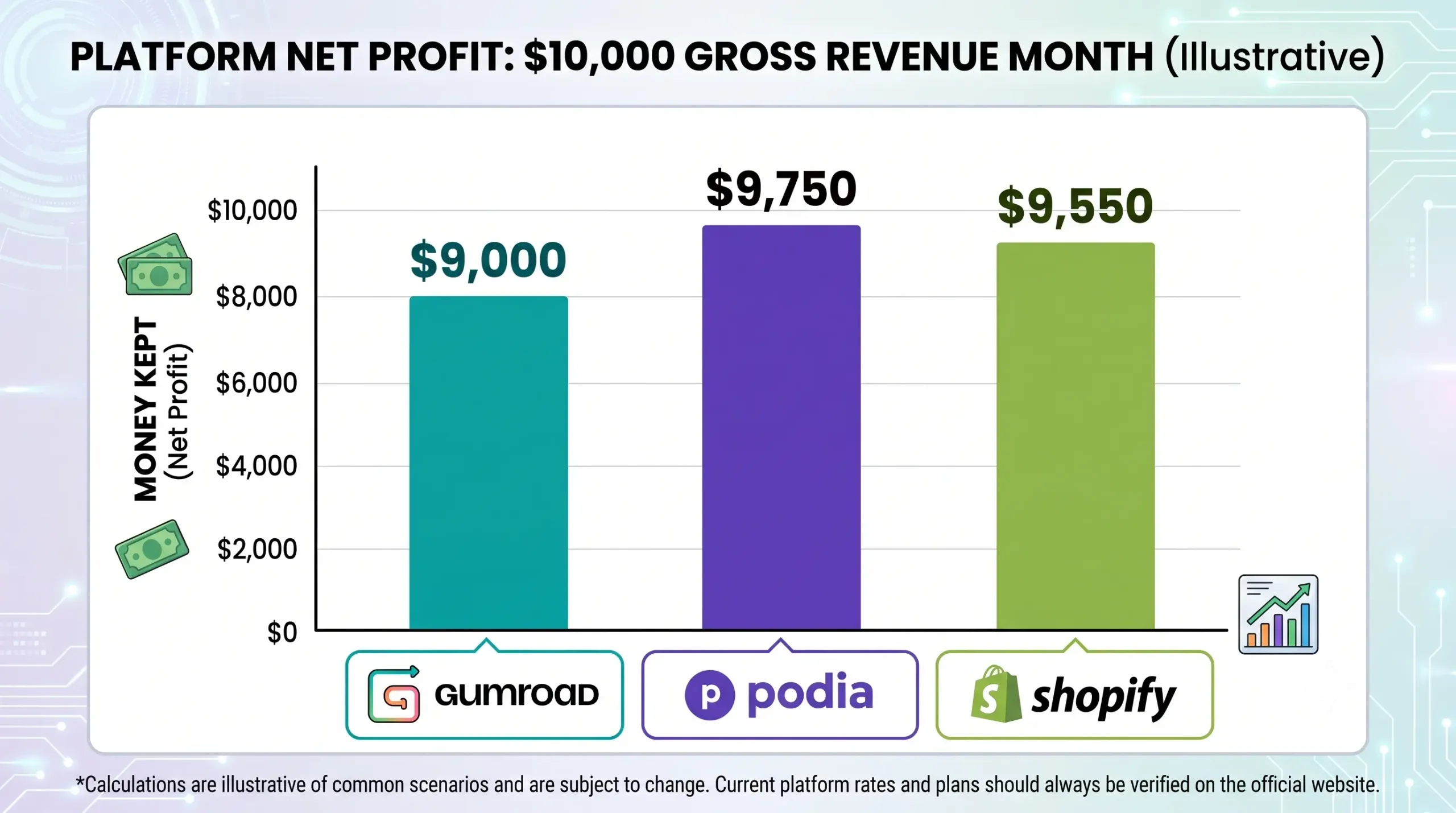
The monthly subscription is genuinely just the entry ticket. Apps, themes, and any custom development stack on top — mid-market brands commonly spend $350 to $1,400 a month just on apps. At $10,000 in monthly revenue using Shopify Payments, total fees land around $389; the same volume routed through PayPal instead runs closer to $596.
Who it’s actually for: creators selling digital products alongside physical merchandise, or anyone who needs a genuinely flexible storefront with a real app ecosystem behind it — not creators who just need a simple checkout link for one ebook.
Head-to-Head: The Numbers Side by Side
| Gumroad | Podia (Mover) | Shopify (Basic) | |
| Monthly fee | $0 | $33–$42 | $29–$39 |
| Per-sale fee | 10% + $0.50 | 5% | 0% (Shopify Payments) |
| Best for volume | Low, occasional | Low–mid, recurring | Mid–high, scaling |
| Built-in email marketing | No | Yes | No (app required) |
| Handles physical products | No | No | Yes |
| Refund fee policy | Keeps full fee | Standard Stripe only | Standard Stripe only |
Which One Actually Fits You
- Just testing an idea, unsure if it’ll sell at all? Gumroad. Zero monthly commitment means zero risk if the product flops.
- Selling a genuine mix — courses, downloads, coaching — and want it all under one login with email built in? Podia, and go straight to Shaker if you’re already clearing more than a few thousand dollars monthly.
- Building a real brand, possibly with physical products down the line, or needing serious customization? Shopify, budgeted honestly — subscription plus processing plus at least a couple of apps.
None of these platforms is objectively “the best.” They’re built for different shapes of business, and the fee structures reflect that on purpose — Gumroad bets on your first sale, Podia bets on your recurring mix, Shopify bets on your long-term scale. Match the platform to your actual sales volume and product mix, not to whichever name shows up first in a Google search, and the decision gets a lot less complicated than it looks from the outside.

Related posts

The Problem: You Have to Pick Somewhere to Start You want to sell something online. Great instinct — but “something” splits almost immediately into two...

At Build 2026, Microsoft quietly previewed something that actually looks smart: Project Solara. Three layers, stacked on top of each other. First, an operating system...

Here’s a number that should stop you mid-scroll: across 146,271 products analyzed on Gumroad in 2026, the median creator earned $72 a month. Not $72,000....

Five years ago, launching a digital product meant weeks of writing, editing, designing, and second-guessing your own copy at 1 a.m. Now a solo creator...

For most of the last decade, running enterprise Linux without paying Red Hat’s licensing fees meant one thing: find a distribution that copies RHEL exactly,...
Add comment