
No products in the cart.
Digital Product Business Scope in 2026: The Real Numbers Behind the Boom
Problem
Everyone’s telling you the same thing right now. Quit the job, build a course, sell an ebook, watch the passive income roll in while you sleep. It’s become background noise at this point — the kind of advice so repeated it stops meaning anything. So here’s the actual question worth asking: is there still real opportunity in digital products in 2026, or did you show up to a party that already ended?
Agitation
The scary version of the answer is: it depends entirely on where you’re standing.
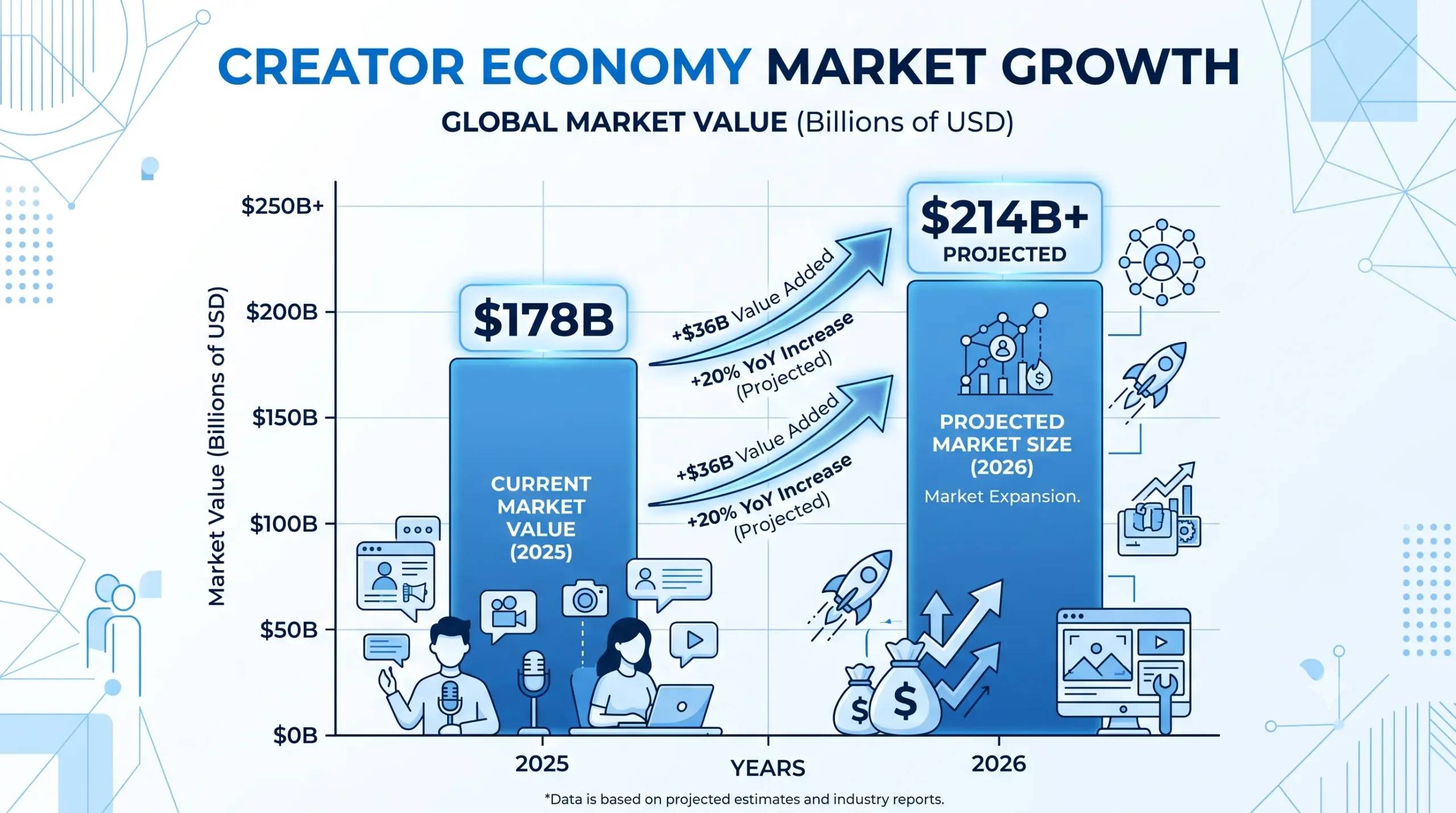
Because yes, the market is enormous and still growing. The global creator economy sat around $178 to $255 billion in 2025 depending on which research firm you trust, and most projections put 2026 somewhere between $214 billion and $325 billion, expanding at a compound annual growth rate that different analysts peg anywhere from 22% to nearly 31%. That’s not modest growth. That’s a market roughly doubling every three to four years.
But bigger market doesn’t automatically mean easier entry. It usually means the opposite. More sellers, more noise, more competition for the same attention. Digital product transactions specifically surged 70% between 2022 and 2024, and roughly 68% of internet users now pay for some form of digital content monthly — which sounds like great news until you realize every other creator read the same statistic and had the same idea you did.
And the earnings data underneath all that market-size optimism is genuinely uneven. Across broader creator economy studies, only about 1 to 5% of creators earn what anyone would call significant income. The rest deal with volatility — ad revenue swings, sponsorship gaps, inconsistent product sales, the kind of financial unpredictability that makes budgeting nearly impossible. If you’ve been picturing digital products as some guaranteed passive-income machine, the actual distribution of outcomes looks a lot more like a lottery with better odds than most, not a sure thing.
Solution
Here’s where it gets more useful, though — because the data doesn’t just show “it’s competitive.” It shows exactly where the competition is thinnest, and that’s the part worth paying attention to.
Start with scale. Digital products specifically — courses, ebooks, templates, software, paid communities — represent roughly $32 billion carved out of that larger $290 billion creator economy, making them the single fastest-growing revenue segment outside pure ad deals and sponsorships. That’s a real, quantifiable slice of the pie, and it’s growing faster than the whole.
Now look at where the money’s actually concentrating by platform. Teachable holds around 15% market share, almost entirely in high-ticket course sales, with an estimated $480 million in gross merchandise value moving through it in 2026. Systeme.io is growing the fastest of the major platforms — 28% year over year — now sitting around 12% share, largely because it bundles funnel building, email, and course hosting into one tool rather than forcing creators to stitch five platforms together. It’s particularly dominant in European and Latin American markets, a detail most US-focused creators completely overlook. Whop, meanwhile, has carved out roughly 25% of the specific paid-community segment by leaning into Discord-native audiences, mostly younger creators building recurring subscription income rather than one-off product sales.
Margins tell an even more compelling story. Digital product creators typically run profit margins between 70% and 90% — numbers that would be laughable in almost any physical product business, where inventory, shipping, and returns eat into everything. Online courses and membership models sit at the high end of that range, often 85% to 95%, because once the content exists, delivering it to the thousandth customer costs almost nothing extra.
Geography matters more than most people account for, too. Asia Pacific is projected to represent roughly a third of the entire global creator economy market in 2026, and it’s the fastest-growing region by a wide margin — driven by mobile-first audiences and massive social commerce adoption in markets like India and China. India alone has somewhere between 2 and 2.5 million active digital creators according to government figures, with YouTube reporting more than 100 million Indian channels uploaded content in a single year. North America still leads in raw revenue share, sitting around 33%, but the growth curve increasingly points elsewhere.
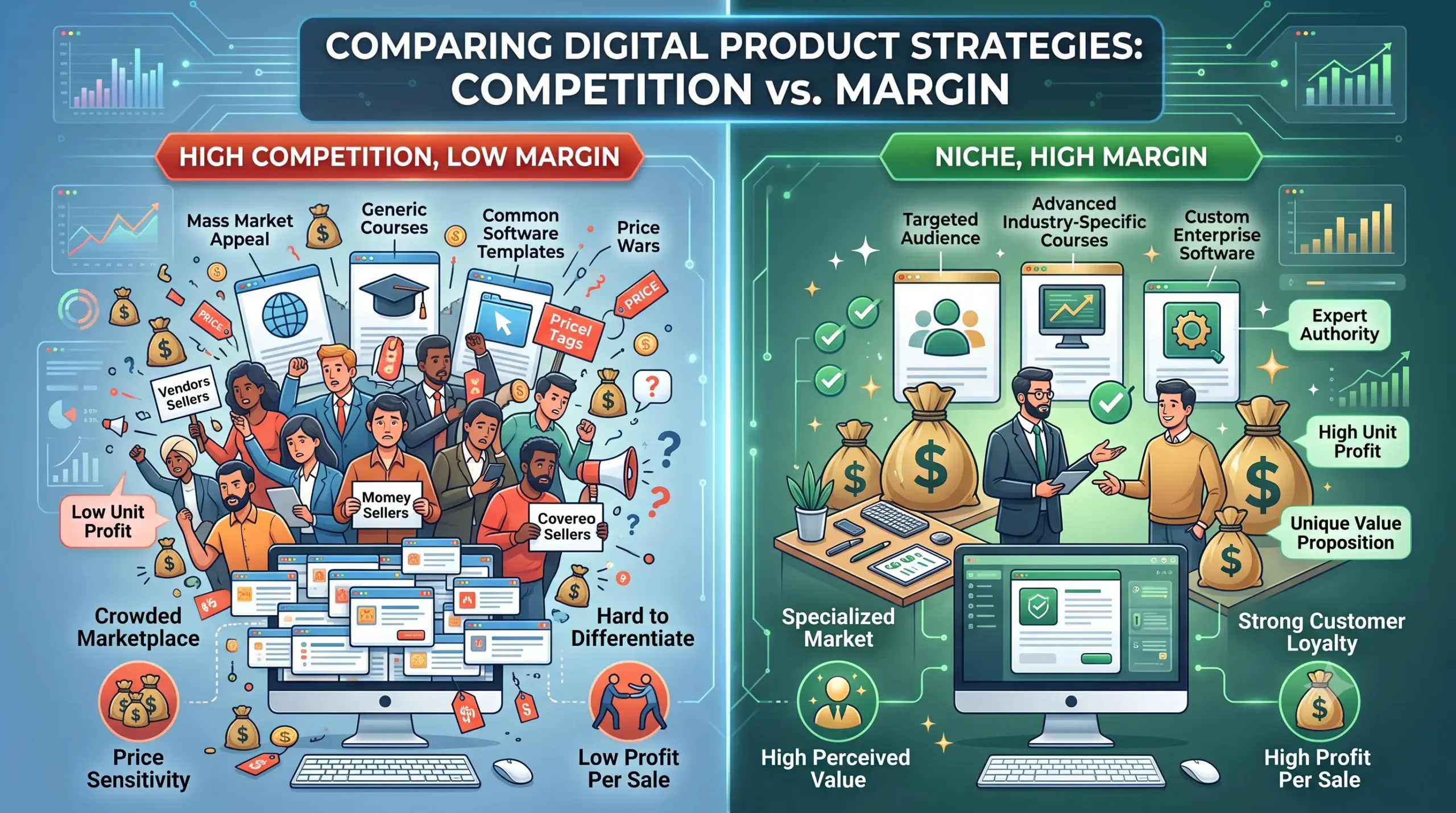
And then there’s the niche data, which is honestly the most actionable piece of all this. Broad categories are saturated — everyone’s selling a generic productivity ebook or a generic Notion template, and that competition compresses prices toward the bottom. But specific, underexplored niches are quietly outperforming by wide margins. Writing and publishing products, for instance, average close to $15,750 per product in one recent dataset spanning tens of thousands of listings — despite a relatively small pool of competing products. Fitness and health niches show similar patterns, averaging over $11,000 per product. The pattern holds everywhere you look: narrow, specific, underserved categories out-earn broad, obvious ones almost every time.
There’s one more number worth sitting with before wrapping this up: average subscription churn across digital product businesses runs around 5.3% monthly. That means roughly one in twenty subscribers cancels every single month, which compounds into serious annual attrition if you’re not actively working to retain people — through community, ongoing content updates, or genuine engagement rather than a set-it-and-forget-it product.
So what’s the actual scope here, heading into the rest of 2026? Real. Substantial. Genuinely still expanding at a pace most traditional industries would envy. But it rewards specificity over breadth, audience-building over hope, and retention over one-time sales. The creators pulling in real numbers aren’t the ones who found some secret nobody else knows. They’re the ones who picked a narrow enough lane, built the audience before the product, and treated churn as seriously as they treated the initial sale. The market’s big enough for more people to succeed in it. It’s just not big enough to reward showing up unprepared.


Related posts
The Opportunity, Stated Plainly The U.S. creator economy sat near $50.9 billion in 2024. Estimates for the wider market now range from $80 billion to...

Problem You’re staring at a blank document, cursor blinking, trying to think of a digital product to sell. Nothing comes. Or worse — five ideas...

You built the thing. The checkout page works. The landing page looks sharp. And now you’re staring at an empty analytics dashboard, refreshing it every...
You’ve built the thing. Now you need somewhere to sell it — and the internet hands you three names on repeat: Gumroad, Podia, Shopify. Each...

The Problem: You Have to Pick Somewhere to Start You want to sell something online. Great instinct — but “something” splits almost immediately into two...
Add comment