
No products in the cart.

Market Your Digital Product With a Zero-Dollar Advertising Budget
You built the thing. The checkout page works. The landing page looks sharp. And now you’re staring at an empty analytics dashboard, refreshing it every ten minutes like it’s going to magically fill up on its own.
It won’t. Not without traffic. And traffic costs money — or does it?
The Problem: No Budget, No Visibility
Here’s the uncomfortable math nobody tells first-time founders. Paid acquisition for an unproven digital product is brutal. Early paid campaigns on channels like Google Ads regularly run customer acquisition costs into the hundreds of dollars — for products that might sell for a fraction of that. Ad platforms don’t care how good your product is. They care how much you’re willing to bid, and beginners almost always overpay while they figure out targeting.
So you sit there with zero dollars and a product nobody’s heard of. Meanwhile, competitors with funding are buying their way to the top of search results. It feels like showing up to a gunfight with a butter knife.
Agitate: Why “Just Go Viral” Isn’t a Strategy
Somebody in your Slack or Discord has already told you to “just post on Twitter” or “make a TikTok, it’ll blow up.” Cool advice. Vague, useless, and wrong for most products.
Here’s what actually happens when founders chase virality with no plan:
- They post inconsistently, get no traction, and quit after two weeks.
- They copy tactics from a company at a completely different stage, with a completely different audience.
- They confuse attention with customers — a viral post that doesn’t convert is just noise.
The real problem isn’t lack of budget. It’s lack of a repeatable system. Money is a shortcut around building distribution. Without money, you have to build it the slow way — and most people give up before the slow way starts working.
Ask yourself: are you optimizing for a lucky spike, or a system that compounds?
Solve: What Actually Works (With Receipts)
Zero-dollar marketing isn’t a myth. It’s a discipline. Below are two documented cases, both audited and referenced repeatedly in growth marketing circles, showing exactly how it’s done.
Case Study 1 — Dropbox’s Referral Loop
Dropbox launched in 2008 into a market that barely understood cloud storage. Early paid experiments on Google AdWords were a disaster: customer acquisition cost landed somewhere between $233 and $388 for a product priced at $99 a year. That math doesn’t work. Ever.
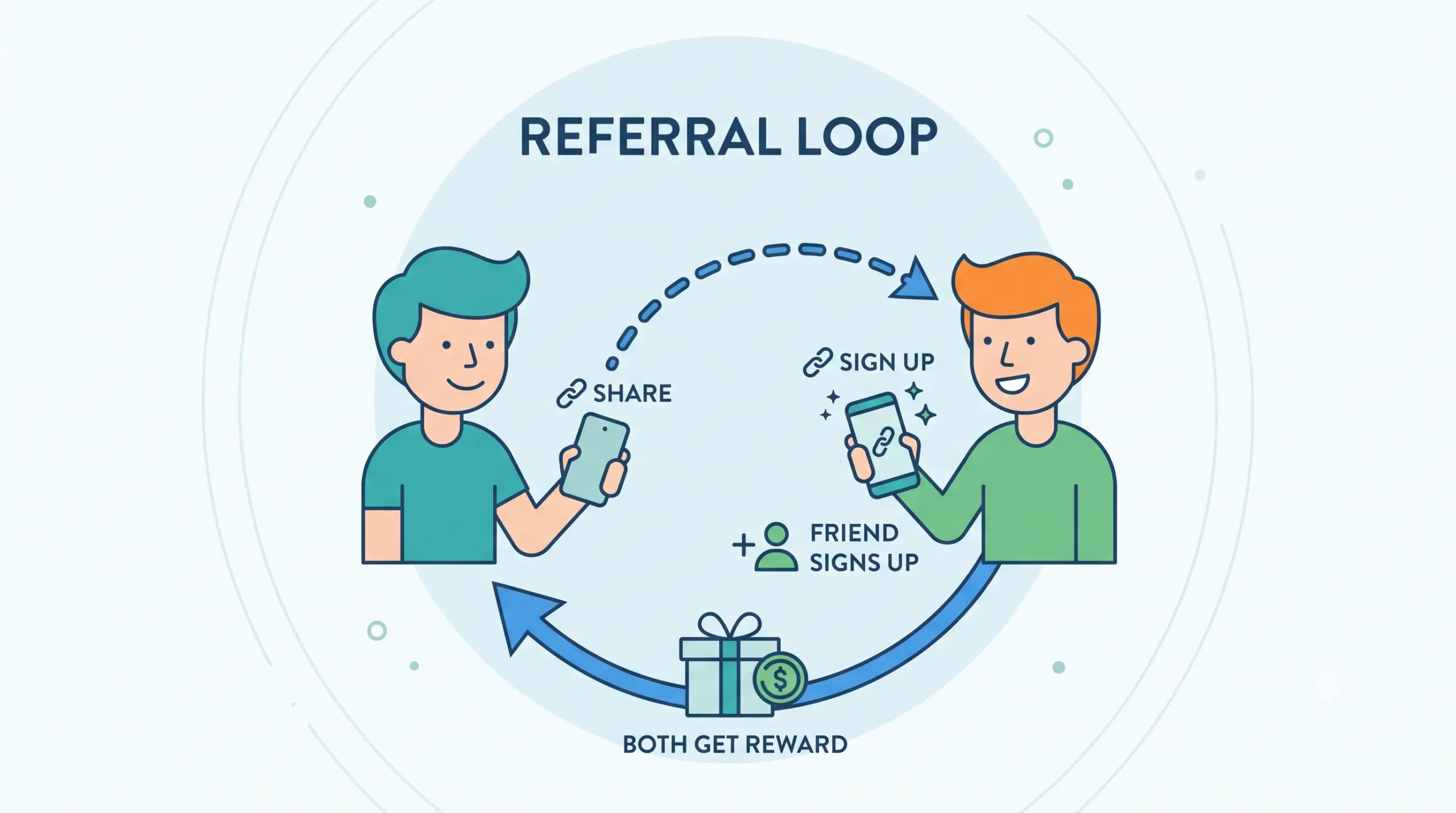
So Dropbox pivoted to referrals instead. The mechanic was dead simple — invite a friend, both people get extra storage. No cash. No ad spend. Just product-native incentive.
The results, tracked over the following months:
- Signups jumped from 100,000 to 4 million in 15 months — a 3,900% increase.
- The program permanently lifted signups by 60%.
- Users sent 2.8 million invites in a single month at peak.
- Referrals eventually outpaced Dropbox’s paid channels by 2.8×.
One detail most people skip: a third of Dropbox’s signups were already arriving through word of mouth before the referral program launched. The program didn’t invent demand — it gave existing enthusiasm a mechanism to spread. That’s the lesson. Referral systems amplify what’s already working; they don’t create interest from nothing.
Sub-lesson for digital product owners:
- Give something the user actually wants, not a token gesture.
- Put the sharing option where users already are, not buried three menus deep.
- Reward both sides of the referral, not just the referrer.
Case Study 2 — Buffer’s 150 Guest Posts
Buffer’s co-founder, Leo Widrich, took a different route entirely: guest blogging. Over roughly 9 months, he wrote and published around 150 guest posts on other people’s blogs — some small, some larger publications, none of them paid placements.
The outcome: Buffer signed up its first 100,000 users largely through that guest-posting effort.
It wasn’t glamorous. Early guest posts barely moved the needle. Widrich has said as much himself — traffic only improved gradually as he built relationships and refined which topics actually resonated with readers. This wasn’t luck. It was volume plus iteration: write, observe what performs, adjust, repeat.
Sub-lesson for digital product owners:
- Consistency beats intensity. Two to three posts a week for months outperforms one viral swing.
- Track what works and double down — don’t reinvent your approach every week.
- Guest content works because it borrows someone else’s audience. You’re not building traffic from zero; you’re renting attention that already exists.
Putting This Into Practice: A Starting Checklist
You don’t need Dropbox’s engineering team or Buffer’s writing stamina on day one. Start smaller:
- Pick one channel where your exact audience already gathers.
- A subreddit, a niche newsletter, a Discord server, a specific hashtag community.
- Build one mechanism people can share without thinking hard.
- A referral link, a free tool, a template, something genuinely useful on its own.
- Publish somewhere that already has readers.
- Guest posts, podcast interviews, community AMAs — borrowed audiences, zero cost.
- Track just one number.
- Signups per week. Not vanity metrics. Not likes. Just: is this compounding?
- Repeat for 90 days before judging the results.
- Buffer’s traffic barely moved for months. Then it didn’t.
The Real Cost of “Free” Marketing
Zero-dollar advertising doesn’t mean zero-cost. It costs time, consistency, and a willingness to be unglamorous for a while. Dropbox didn’t skip effort — they engineered a loop instead of buying eyeballs. Buffer didn’t skip effort — they traded ad spend for a typewriter and sheer output.
So, what’s your zero-dollar mechanism going to be? A referral loop baked into your product? A relentless guest-posting cadence? A tool people bookmark and pass around?
Pick one. Commit to it for a real stretch of time — not two weeks, not until the first slow Tuesday. And measure it honestly.
Further Reading
Related posts
You’ve built the thing. Now you need somewhere to sell it — and the internet hands you three names on repeat: Gumroad, Podia, Shopify. Each...

The Problem: You Have to Pick Somewhere to Start You want to sell something online. Great instinct — but “something” splits almost immediately into two...

At Build 2026, Microsoft quietly previewed something that actually looks smart: Project Solara. Three layers, stacked on top of each other. First, an operating system...

Here’s a number that should stop you mid-scroll: across 146,271 products analyzed on Gumroad in 2026, the median creator earned $72 a month. Not $72,000....

Five years ago, launching a digital product meant weeks of writing, editing, designing, and second-guessing your own copy at 1 a.m. Now a solo creator...
Add comment