
No products in the cart.

How Is Artificial Intelligence Changing the Way We Create and Sell Digital Products?
Five years ago, launching a digital product meant weeks of writing, editing, designing, and second-guessing your own copy at 1 a.m. Now a solo creator can generate a course outline, product descriptions, cover art, and an email sequence before lunch. That’s not a prediction. That’s just Tuesday.
So what actually changed, and does it hold up under scrutiny? Let’s dig in.
The Problem: Creating Digital Products Used to Be Slow, Expensive, and Bottlenecked by One Person
Building a digital product — an ebook, a course, a template pack, a piece of software — has always required the same grinding sequence of tasks. Research. Draft. Revise. Design. Price. Market. Repeat for every single product page.
For solo creators and small teams, this sequence is brutal:
- Writing hundreds of product descriptions by hand for a growing catalog takes days, sometimes weeks.
- Design work either costs real money or eats into the founder’s own time.
- Marketing copy — the emails, the ad text, the landing pages — competes for the same limited hours as actually building the product.
Here’s a case in point. GoSparky, a UK electrical distributor scaling toward 30,000 products, had a two-person team spending days manually hunting down specs from manufacturer websites just to write a single product description. Multiply that by thousands of SKUs and you get a backlog that never actually clears.
That’s the old bottleneck. One person, one keyboard, a finite number of hours in a day.
Agitate: The Old Way Doesn’t Scale, and Everyone Knows It
Here’s the uncomfortable part. Even when creators push through the grind, the output is often inconsistent. Tone shifts between product pages written on a good day versus a rushed one. Descriptions go stale. Catalogs sit half-finished for months because nobody has time to finish them.
And the market isn’t waiting around. Consider what’s happening at scale:
- The digital products economy now generates more than $2.5 trillion in value annually.
- Generative AI adoption has climbed 250% since 2023.
- 93% of marketers report using AI to speed up content creation in some form, with 63% specifically leaning on generative AI for written content.
If your competitors are shipping product pages, email sequences, and course modules three times faster than you are, “I’ll get to it eventually” stops being a viable plan. Speed became table stakes, not a nice-to-have.
There’s also a subtler problem creeping in: sameness. As more sellers lean on the same handful of AI tools with the same default prompts, output starts to blur together. 75% of marketers say they’re actively worried about AI-generated content losing its distinctiveness. That’s a real tension worth sitting with — speed is good, but speed that produces indistinguishable copy isn’t actually winning you anything.
So: how do you get the speed without losing the voice that made your product worth buying in the first place?
Solve: What AI Actually Changes — With Receipts
This is where the data gets interesting, because the results aren’t hypothetical anymore. Multiple retailers and creators have published real, measurable outcomes.
Case Study 1 — Shopify Magic and Product Descriptions
Shopify built AI-powered product description generation directly into its merchant dashboard. Merchants type in a few keywords, and the tool drafts copy in seconds.
One documented result: a two-person indie apparel brand used Shopify Magic to generate descriptions for an entire new collection and saw an 18% lift in conversion rate, attributed to stronger product storytelling than the founders had time to write themselves.
The CEO of apparel brand Glitch Anomaly put it simply: feeding the tool desirable SEO keywords let the team “work more efficiently and save costs” — a small operation punching above its weight because the writing bottleneck disappeared.
Case Study 2 — Migros and Wayfair at Larger Scale
It’s not just small shops. Swiss retailer Migros replaced standard manufacturer descriptions with AI-enhanced, benefit-driven copy and saw a 23.7% increase in conversion rates. That’s not a rounding error — that’s a meaningful shift in how many browsers become buyers.
Wayfair went a different direction, using generative AI to refresh descriptions across thousands of existing listings. The payoff: a 68% reduction in content production time. Seasonal collections that used to take months to prep and publish now launch in days.
Case Study 3 — Bulk Catalog Work Nobody Wants to Do by Hand
Back to GoSparky and the manual-spec-hunting problem. Once they adopted AI-assisted content enrichment — pulling missing product attributes automatically instead of hand-searching manufacturer sites — the bottleneck that had trapped a two-person team for days started clearing in hours instead.
A similar story: gift retailer GiftUniverse processed 78 products in two hours using AI-assisted workflows — a job that previously took close to two weeks of manual effort. Target Australia now runs AI-generated content across 1,000+ products per week, a volume that simply wasn’t achievable through manual writing at their catalog size.
What’s Actually Different About Selling, Not Just Making
Creation is half the story. The other half is how AI is reshaping the selling side.
- Salesforce’s 2025 holiday season data attributes roughly $262 billion, or 20% of all retail sales, to AI and AI agents through product recommendations and shopper engagement.
- Visa’s global holiday study found 47% of U.S. consumers had used AI for at least one shopping task — gift discovery, price comparison, or general product research — before ever reaching checkout.
That means AI isn’t just writing your product page anymore. It’s increasingly the thing standing between your product and the customer, filtering what gets surfaced and recommended in the first place. Worth asking yourself: is your product description written in a way an AI shopping assistant can actually parse and recommend, or only in a way a human skimmer might?
What This Means If You’re Building or Selling a Digital Product Right Now
Pulling the threads together, a few practical takeaways:
- Use AI for volume, not for voice. The strongest results — Migros, Wayfair, Shopify Magic case studies — came from AI handling repetitive drafting work while humans still shaped tone and positioning. Full autopilot tends to produce the “sameness” problem 75% of marketers are worried about.
- Feed it real product data, not vague prompts. Sparse input produces generic output — that’s true whether you’re using ChatGPT manually or a dedicated tool. GoSparky’s breakthrough came from better data enrichment, not just faster typing.
- Build a review gate. Every case study with strong, sustained results — not just a one-time spike — paired AI generation with a human review step before publishing. Speed without a quality check just means shipping mistakes faster.
- Think about AI shoppers, not just human ones. With a fifth of retail sales now touched by AI recommendation engines, product copy that’s structured clearly — specs, benefits, use cases spelled out — has a better shot at being surfaced by an AI assistant than copy written purely for human scanning.
A Few Questions Worth Asking Before You Lean In Further
- Is your current product catalog actually finished, or has AI just let you paper over gaps faster?
- If a competitor is shipping three times the content volume you are, what’s your actual differentiation now — price, voice, or something else entirely?
- Are you measuring conversion lift the way Migros and Shopify Magic users did, or just assuming AI helped because it feels faster?
The Bigger Picture
AI didn’t remove the work of building and selling digital products. It removed the bottleneck — the single person or small team who used to be the only thing standing between an idea and a finished, published product. That’s a real shift, and the conversion numbers from Migros, Wayfair, and Shopify Magic users back it up with actual percentages, not vibes.
But the tools that work best aren’t the ones running on full autopilot. They’re the ones plugged into good data, checked by a human, and aimed at a customer — human or algorithmic — who’s going to actually read what comes out the other end.
Further Reading


Related posts
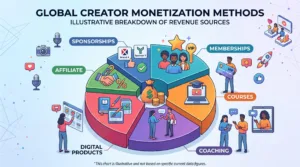
The Opportunity, Stated Plainly The U.S. creator economy sat near $50.9 billion in 2024. Estimates for the wider market now range from $80 billion to...

Problem You’re staring at a blank document, cursor blinking, trying to think of a digital product to sell. Nothing comes. Or worse — five ideas...
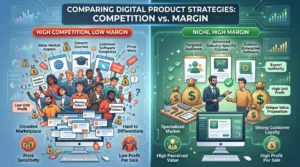
Problem Everyone’s telling you the same thing right now. Quit the job, build a course, sell an ebook, watch the passive income roll in while...

You built the thing. The checkout page works. The landing page looks sharp. And now you’re staring at an empty analytics dashboard, refreshing it every...
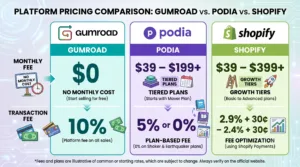
You’ve built the thing. Now you need somewhere to sell it — and the internet hands you three names on repeat: Gumroad, Podia, Shopify. Each...
Add comment