
No products in the cart.

What Are the Most Profitable Digital Products to Sell Right Now?
Here’s a number that should stop you mid-scroll: across 146,271 products analyzed on Gumroad in 2026, the median creator earned $72 a month. Not $72,000. Seventy-two dollars. And 44% of all products on the platform generated exactly $0.
So when someone tells you digital products are “easy passive income,” they’re leaving out the part where most people make almost nothing. Let’s fix that gap with actual numbers instead of vibes.
The Problem: Everyone’s Chasing the Same Five Product Ideas
Open any “sell digital products” guide and you’ll see the same list — ebooks, planners, Notion templates, printables, courses. Not wrong, exactly. Just crowded.
Here’s what that crowding actually looks like in the data:
- Software Development is Gumroad’s biggest category by total revenue — $65.8 million, averaging $60,814 per product.
- But that average is deceiving. A single AI Photoshop script, the Nano Banana & Flux AI tool, pulled in $586,000 on its own, dragging the category average way up while most sellers in it earn far less.
- Organic search drives only 12% of Gumroad sales — the platform doesn’t actively surface individual seller pages, so you’re mostly on your own for traffic.
Translate that: pick the “hot” category everyone’s piling into, and you’re often competing against a handful of outliers skewing the averages, while getting almost no organic discovery to help you catch up.
Agitate: Why “Just Make a Digital Product” Advice Fails Most People
Here’s where it gets uncomfortable. The advice floating around social media — “just make a template, passive income, easy” — skips the part where distribution and niche selection matter more than the product itself.
Consider the platform math:
- Etsy has roughly 4x more buyer traffic than Gumroad, which matters enormously if you don’t already have an audience.
- Gumroad charges a flat 10% fee — the highest of any major platform — on top of whatever payment processing takes.
- Nearly half of all Gumroad products earn nothing at all, which means the “make a template and watch the money roll in” fantasy fails for the majority of people who try it.
So why do some sellers hit five and six figures a month while most hit zero? It’s rarely the format. It’s positioning, niche depth, and — this part gets skipped constantly — picking categories where competition is thin and buyer intent is high, instead of chasing whatever’s trending on TikTok that week.
Ask yourself honestly: are you picking a product because the data supports it, or because you saw someone else’s screenshot of a good month?
Solve: What’s Actually Profitable Right Now, Backed by Numbers
Let’s get specific. Here’s what’s working, with real figures attached.
1. Niche Templates and Business Toolkits
Business startup kits — pitch decks, pricing calculators, brand sheets, launch checklists — bundle several useful documents into one purchase. That bundling matters: buyers perceive more value from five related files than one standalone template, even if the total creation effort barely changes.
- On Etsy, business templates typically sell in the $12–$40 range and skew toward B2B buyers who convert faster than casual browsers.
- Etsy seller Dylan Jahraus, whose shop ranks in the top 0.1% of Etsy shops globally, documented $16,980 in monthly revenue from a strategy built around bundled digital product ecosystems rather than single standalone items.
Why it works: bundles increase average order value while making the buying decision simpler — fewer choices, higher perceived savings.
2. Digital Planners and Organizers
Boring? Maybe. Profitable? Consistently.
- Digital planners on Etsy sell for roughly $8–$25 each with margins around 95%, since there’s no material cost and delivery is instant.
- These sit in a category buyers return to repeatedly — a planner sold once often gets repurchased as an updated yearly version, creating a built-in reason for repeat business.
3. Writing & Publishing — The Quiet High Earner
This is the category most people skip, and that’s exactly the point.
- Writing & Publishing products on Gumroad earn $15,750 per product on average — the highest revenue-per-product of any standard category — across just 226 products total.
- Compare that to Software Development’s crowded field pulling massive totals mostly from a few outlier scripts. Writing & Publishing has far less competition and a median of 41 sales per product — a realistic, achievable number for a new seller.
Why it works: thin competition plus real buyer demand is a better combination than a hot category flooded with sellers.
4. Wedding and Event Templates
Niche-specific, emotionally driven purchases tend to convert well because buyers aren’t comparison shopping the way they do for generic templates.
- Wedding templates and printables sell for $15–$50 on Etsy — a notably higher price point than generic planners, because buyers associate weddings with higher stakes and are less price-sensitive in that moment.
5. Educational Printables for Teachers
Smaller price point, but a loyal, repeat-buying audience.
- Educational printables sell for $3–$20, and this category benefits from teachers who return each semester for fresh material — a natural repeat-customer cycle most other categories don’t get for free.
A Quick Reality Check on “Passive” Income
None of the above is instant. Realistic early-stage numbers for new Etsy digital product sellers, based on aggregated seller data, look roughly like this:
- Month 1: $100–$300
- Month 3: $500–$1,500
- Month 6: $1,000–$3,000
- Month 12: $2,000–$8,000+
That’s a ramp, not a jackpot. Anyone promising overnight results is either an outlier or not being straight with you.
How to Actually Pick Your Product (Instead of Guessing)
A short checklist worth running through before you build anything:
- Check revenue-per-product, not just total category revenue. A category with massive totals dragged up by one outlier isn’t the same as a category where the typical seller does well. Writing & Publishing beats Software Development on this exact metric.
- Match the platform to your traffic situation. No existing audience? Etsy’s built-in buyer traffic matters more than Gumroad’s lower fees. Already have followers? Gumroad’s creator-led model and lower dependency on marketplace search might suit you better.
- Favor bundles over singles once you’ve validated one product. The data consistently shows higher average order values from bundled ecosystems versus one-off templates.
- Pick a category with a natural repeat-purchase reason. Planners, teacher printables, and wedding templates all have built-in reasons buyers return — annual updates, new semesters, new events.
Questions Worth Sitting With Before You Launch
- Is your product idea competing in a category where 44% of sellers earn zero, or one where the median product still pulls in real sales?
- Do you have existing traffic, or does your platform need to bring the buyers for you?
- Does your product give someone a reason to come back next month, or is it a one-and-done purchase?
The Bottom Line
“Most profitable digital product” isn’t a single answer — it’s a function of category competition, platform traffic, and whether your product gives buyers a reason to return. The sellers pulling real numbers aren’t necessarily picking flashier products. They’re picking underserved categories, like Writing & Publishing’s quiet $15,750-per-product average, or building bundled ecosystems instead of single templates competing in an oversaturated space.
Chase the data, not the screenshot.
Further Reading


Related posts

The Opportunity, Stated Plainly The U.S. creator economy sat near $50.9 billion in 2024. Estimates for the wider market now range from $80 billion to...

Problem You’re staring at a blank document, cursor blinking, trying to think of a digital product to sell. Nothing comes. Or worse — five ideas...

Problem Everyone’s telling you the same thing right now. Quit the job, build a course, sell an ebook, watch the passive income roll in while...

You built the thing. The checkout page works. The landing page looks sharp. And now you’re staring at an empty analytics dashboard, refreshing it every...
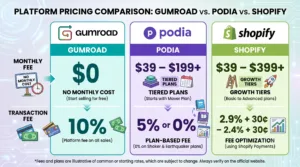
You’ve built the thing. Now you need somewhere to sell it — and the internet hands you three names on repeat: Gumroad, Podia, Shopify. Each...
Add comment