
No products in the cart.
China’s Record Robotic Leaps Show the Limits of Human Speed
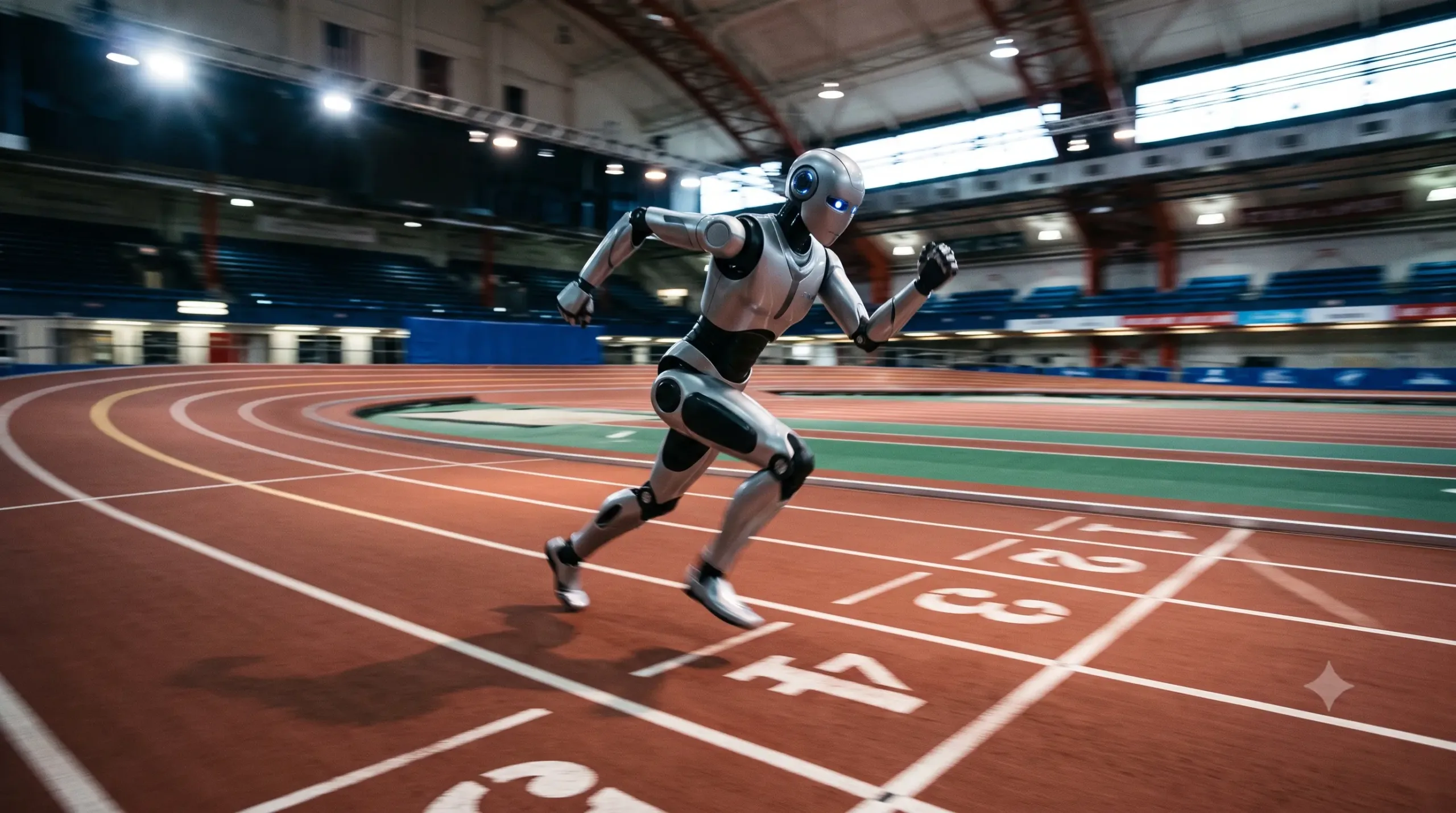
Usain Bolt ran 100 meters in 9.58 seconds. That number stood for 17 years. Nobody touched it. Not another sprinter, not a faster shoe, not a better track surface. Then, on a Saturday in Beijing, a machine did it in 9.39 seconds.
Let that sit for a second.
The Problem: Humans Just Hit a Wall
Elite sprinting is a game of milliseconds. Athletes shave hundredths off a personal best after years of training, and the entire sport treats that as a triumph. Bolt’s 2009 record has survived a full generation of professional athletes trying to beat it. Nobody has.
That’s not a coincidence — it’s biology. Muscle fiber, tendon recoil, oxygen delivery, reaction time. Humans are bumping against a hard ceiling built into the body itself. No amount of coaching rewrites your fast-twitch fiber count.
So what happens when a competitor shows up that isn’t limited by any of that?
Agitate: The Numbers Get Uncomfortable Fast
At the second World Humanoid Robot Games, held in Beijing’s National Speed Skating Oval in August 2026, more than 2,000 humanoid robots competed across 51 events. A humanoid robot ran the 100-meter sprint in 9.39 seconds, beating Usain Bolt’s 9.58-second world record from 2009.
That’s one result. Here’s what should actually worry you if you’re rooting for Team Human:
- High jump: A humanoid robot cleared 2.88 meters in the standing high jump — far above the 0.95-meter best a humanoid managed just one year earlier at the first edition of the games. That’s not incremental progress. That’s a threefold jump in twelve months.
- Long jump: A robot reportedly launched itself 7.97 meters — creeping within 0.98 meters of Mike Powell’s 8.95-meter human world record set back in 1991, a mark that’s stood for over three decades.
- Distance running: Reports out of the same event describe a robot breaking a 1500-meter benchmark as well, stacking speed records on top of jump records in the same week.
Read those three bullet points again. Sprint, jump, distance. Three different disciplines, three different muscle demands, and machines are closing — or beating — the gap in all of them, in the same tournament, within the same five days.
Here’s the part that should actually make you pause: last year’s high jump number was 0.95 meters. This year it’s 2.88. If that rate of improvement holds anywhere close to steady, where does 2027 land? Nobody in athletics has ever had to answer that question before, because human bodies don’t improve threefold in a year. Machines apparently can.
Why This Isn’t Just a Novelty Act
It’s tempting to write this off as robots doing party tricks — cool footage, no real substance. That take doesn’t survive contact with the numbers.
- China recorded over 140 humanoid robot manufacturers in 2025 alone, with more than 330 distinct humanoid models launched that same year.
- Sixteen countries sent teams to the Beijing games, including Germany, Japan, and the United States — this wasn’t a domestic showcase, it was an international field.
- “Embodied AI” — the umbrella term for robots that physically interact with the world rather than just processing data — was written into China’s Government Work Report as a national priority, then reinforced again in the country’s 15th Five-Year Plan as a designated driver of economic growth.
This is policy-backed, manufacturing-backed, and now performance-backed. That’s three legs of a stool that usually don’t align this fast.
Solve: What Actually Changed Under the Hood
So how did a robot go from 0.95 meters to 2.88 meters in a single year? A few things converged:
- Actuator power density improved. Robots jump using motors and hydraulics instead of tendons, and those components got lighter and stronger between competitions.
- Balance and landing control matured. A high jump isn’t just about explosive force — it’s about not faceplanting on the way down. Better control algorithms mean less energy wasted on stabilization.
- Manufacturing scale drove iteration speed. With over 330 humanoid models launched in a single year, engineers are running far more design experiments than any single company could manage alone. More attempts, faster learning.
Compare this to how slowly human athletic records move. A world record broken by 0.01 seconds makes headlines. A robot high jump record tripling in twelve months barely gets the same scrutiny it deserves — probably because it’s easy to dismiss “it’s just a robot” without sitting with what that trajectory actually implies.
A Reality Check Worth Naming
Not everyone is cheering this on uncritically. The geopolitical layer here is real: the Pentagon has added Unitree, one of China’s leading humanoid manufacturers, to a list of companies it says has ties to the Chinese military. Beijing has pushed back on those claims. That tension doesn’t erase the athletic numbers, but it does mean this story isn’t purely about sport — it’s tangled up with a broader tech and security competition between China and the U.S.
So is this exciting or unsettling? Honestly — probably both, depending on which chart you’re staring at.
What This Means Going Forward
Humans aren’t going to get meaningfully faster. That ship sailed decades ago, and the sprint and jump record books barely move now, year over year. Machines don’t have that ceiling — not yet, anyway. Every actuator upgrade, every algorithm tweak, every manufacturing cycle stacks directly onto the next competition’s results.
A few questions worth sitting with:
- If a robot beats the human sprint record by 0.19 seconds this year, what does that gap look like at the next games?
- Does “world record” even mean the same thing once machines are entering the conversation?
- How long before these same actuator and balance breakthroughs show up outside stadiums — in warehouses, disaster response, or manufacturing floors?
Nine years of humanoid robotics headlines built up to this moment, and the numbers from Beijing suggest the pace isn’t slowing down. Bolt’s record stood for 17 years. The robot that beat it might not hold its own title nearly that long.
Further Reading


Related posts

The Opportunity, Stated Plainly The U.S. creator economy sat near $50.9 billion in 2024. Estimates for the wider market now range from $80 billion to...

Problem You’re staring at a blank document, cursor blinking, trying to think of a digital product to sell. Nothing comes. Or worse — five ideas...

Problem Everyone’s telling you the same thing right now. Quit the job, build a course, sell an ebook, watch the passive income roll in while...

You built the thing. The checkout page works. The landing page looks sharp. And now you’re staring at an empty analytics dashboard, refreshing it every...

You’ve built the thing. Now you need somewhere to sell it — and the internet hands you three names on repeat: Gumroad, Podia, Shopify. Each...
Add comment